
Lightweight Material Die Casting in Modern Industrial Manufacturing


Blogpost keywords: lightweight material die casting, aluminum casting production, structural weight reduction
Lightweight material die casting has become increasingly important as manufacturers across automotive, electronics, and industrial sectors pursue better efficiency without sacrificing structural performance.
The demand is no longer limited to reducing material usage alone. OEM buyers now expect components to remain durable, dimensionally stable, and suitable for large-scale production while achieving lower overall weight.
Why Lightweight Material Die Casting Is Reshaping OEM Design Priorities
In many modern products, reducing weight directly affects energy consumption, transportation efficiency, and assembly performance. At SHD Precision Die Casting, we often see lightweight material die casting integrated into projects where traditional steel structures would create excessive mass or manufacturing inefficiency. Aluminum alloys have become one of the most common choices because they offer a balance between strength, castability, and production scalability.
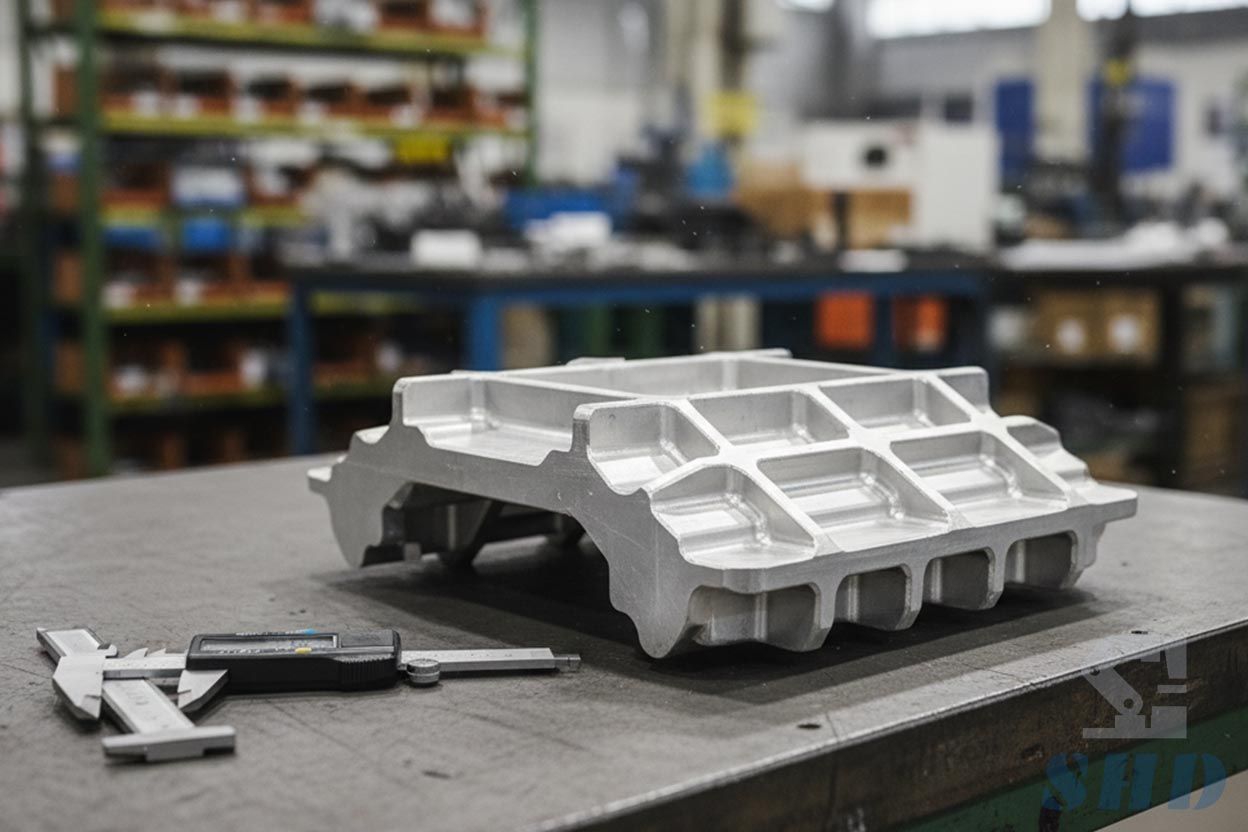
However, successful aluminum casting production involves more than selecting a lighter alloy. Wall thickness distribution, mold filling behavior, cooling control, and rib reinforcement design all influence whether a lightweight structure can remain mechanically reliable during real-world use. In some cases, structural weight reduction actually requires more sophisticated engineering rather than less material.
The Relationship Between Thin-Wall Design and Casting Stability
One of the biggest technical challenges in lightweight material die casting is maintaining stable metal flow inside thin-wall geometries. As wall sections become thinner, molten metal cools more rapidly during injection. If gating systems or venting layouts are not properly optimized, incomplete filling or cold shut defects may occur.
We encountered this issue during an aluminum casting production project involving compact industrial housings. The client initially requested aggressive weight reduction across all surfaces. While the concept reduced material consumption, simulation analysis revealed unstable filling behavior near several corners and reinforcement ribs.
Instead of simply increasing wall thickness again, we adjusted the internal rib structure and optimized gate positioning. This allowed the project to maintain structural weight reduction while improving production consistency.
Common Misconceptions About Lightweight Components
A common misunderstanding is assuming that lighter components are automatically weaker. In reality, lightweight material die casting often relies on geometry optimization rather than material removal alone. Properly designed rib structures, curved reinforcement zones, and controlled wall transitions can significantly improve stiffness without adding substantial mass.
Another misconception is that all lightweight alloys behave similarly in production.
Different aluminum alloys react differently to thermal stress, shrinkage behavior, and surface finishing processes. Aluminum casting production must therefore be matched to the functional requirements of the final product, not only to weight targets.
Practical Considerations for OEM Development
For OEM buyers, structural weight reduction should be evaluated alongside manufacturing repeatability. Features that appear efficient in CAD models may create difficult mold release conditions or unstable filling patterns during actual production. Early collaboration between design and die casting engineering teams helps avoid costly tooling revisions later.
At SHD Precision Die Casting, lightweight material die casting projects are typically reviewed from both structural and production perspectives before tooling begins. This approach improves long-term production stability while maintaining the intended weight-saving goals.
Conclusion
Lightweight material die casting continues to influence modern manufacturing by combining structural efficiency with scalable aluminum casting production and intelligent structural weight reduction strategies.
Engineering Support for Lightweight OEM Production
At SHD Precision Die Casting, we support lightweight material die casting projects through tooling optimization, flow analysis, and production-focused engineering evaluation. Our aluminum casting production capabilities help OEM clients achieve structural weight reduction while maintaining stable large-scale manufacturing performance.